Wednesday, May 4, 2011

KCFC Quarterly Meeting at Shaker Village

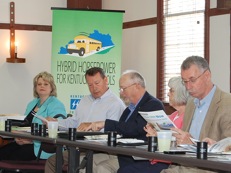
The quarterly meeting was a success with over thirty of the KCFC’s officers and board members showing their support at Shaker Village on Friday April 29th. After a small presentation about the history of Shaker Village, members were updated on KCFC’s finances by Treasurer Vic Peek, and a general update was given by President Tracey Thurman. A presentation on the Green Fleets of the Bluegrass program was given by Emily Sartini. Executive Director Melissa Howell brought the members up to speed on the Hybrid Horsepower for Kentucky Schools project. Lunch was served after a leisurely walk to the dining hall in pleasant weather.
View photos of the meeting on our Facebook page.

Green Fleets of the Bluegrass Program Launched


Green Fleets of the Bluegrass aims to improve the environmental performance of vehicle fleets across Kentucky by reducing petroleum fuel use.

Fleets with significant green initiatives prior to the May 2011 launch of the program may elect an earlier baseline. Fleets without significant green fleet initiatives prior to program launch may elect May 2011 as baseline. Comparative data will be taken on November 1st of each year beginning this year. Participants will be rated according to a three-tier scale based upon seven criteria: vehicles, fuel, maintenance, operation, partnerships, strategy, and transparency.  


Improving fleets show progress in four of the seven areas. Achieving fleets show progress in all seven areas, and Leading fleets show continuous improvement in all seven areas.

KCFC members that submit baseline data by June 30th, 2011 will receive recommendations for initiatives to potentially improve year end ratings. Fleets may also submit baseline and year end data on November 1, 2011.

Friday, April 29, 2011

USDA Rural Development Invites Applications for Renewable Energy and Energy Efficiency Projects

Agricultural Producers in Non-rural Areas are Eligible, Funding May Be Used for Flex-Fuel Pumps

Agriculture Secretary Tom Vilsack has invited agricultural producers and rural small businesses to apply for loans and grants to implement renewable energy systems and make energy efficiency improvements.

“Biofuels and other renewable energy sources present an enormous economic opportunity for rural America and the rest of the nation,” Vilsack said. “President Obama and I recognize that we need to win the future by implementing a long-term strategy to meet our country's current and long-term energy needs. The funding I am announcing today will help make America's farmers, ranchers and rural businesses more energy efficient.”

USDA is providing funding for up to $61 million in guaranteed loans and $42 million in grants through the Rural Energy for America Program (REAP). Funds are available to help agricultural producers and rural small businesses develop renewable energy systems, make energy efficiency improvements and conduct studies to determine the feasibility of renewable energy systems.

State Director Tom Fern said Kentucky’s Rural Development program has already funded several energy-efficiency projects using REAP funds, and his staff is able to process applications from agriculture producers and small rural businesses from a number of locations across the state. Click here for a list of Rural Development’s area offices and the counties they serve.

On Thursday, USDA issued a rule to clarify that the definition of renewable energy systems in REAP includes flexible fuel pumps, sometimes referred to as “blender pumps.” This clarification is intended to provide fuel station owners with incentives to install flexible fuel pumps that will offer Americans more renewable energy options. The Obama administration has set a goal of installing 10,000 flexible fuel pumps nationwide within five years.

The rule also makes the following clarifications:
  • Grants are available for audits of energy improvements and studies to determine the feasibility of renewable energy systems; and
  • Agricultural producers in non-rural areas are eligible for REAP assistance. Small businesses must still be located in rural areas. This clarification makes REAP eligibility requirements consistent with those of other USDA energy programs.
Since Rural Development's renewable energy and energy efficiency programs were launched in 2003, they have played a key role in helping more than 6,000 local businesses create jobs and make energy efficiency improvements. Under REAP, local businesses receive assistance to deploy wind, solar and other forms of renewable energy.

The deadlines for submitting completed REAP applications are June 15 and June 30, depending on the type of project to be funded. For information on applying for assistance, contact your local USDA Rural Development office or see page 20943 of the April 14 Federal Register, http://edocket.access.gpo.gov/2011/pdf/2011-8456.pdf. A list of USDA offices is available at http://www.rurdev.usda.gov/StateOfficeAddresses.html.

USDA, through its Rural Development mission area, administers and manages housing, business and community infrastructure and facility programs through a national network of state and local offices. These programs are designed to improve the economic stability of rural communities, businesses, residents, farmers and ranchers and improve the quality of life in rural America. Rural Development has an existing portfolio of nearly $149 billion in loans and loan guarantees. Visit http://www.rurdev.usda.gov for additional information about the agency's programs or to locate the USDA Rural Development office nearest you.

Hybrid Electric School Bus Delivered in Caldwell County

A new hybrid electric school bus capable of improving fuel efficiency an average of 35% or, from 7 to 11 mpg has joined the fleet of 42 traditional school buses in Caldwell County.

The hybrid electric school bus, manufactured by Thomas Built Buses with the Eaton Hybrid System, was delivered on Tuesday, April 26. The keys to the new hybrid electric school bus were presented to Transportation Director Frank Brown by Bill Glisson, Whayne Supply.

Kentucky will have the distinction of having the largest hybrid electric school bus fleet in the nation. Caldwell County is one of the 30 districts awarded a share of the $13 million in funding from the U.S. Department of Energy, adding a total of 213 hybrid electric vehicles to public school fleets across Kentucky. At approximately $150,000 per vehicle, hybrid electric school buses cost twice as much as traditional school buses. The grant offsets the differential costs for local districts.

“We are encouraging school systems throughout the state to improve efficiency while being environmentally conscious,” says Commissioner Terry Holliday with the Kentucky Department of Education. “The new technology will also provide learning opportunities for students on real-world issues like fuel consumption, air quality and transportation costs.”

The Hybrid Horsepower for Kentucky Schools program is a collaborative effort between the Kentucky Clean Fuels Coalition (KCFC) and the Kentucky Department of Education. Performance data for these hybrid electric school buses will be gathered by KCFC, a non-profit organization.

“Kentucky students will be interactive participants in the hybrid electric school bus project,” says Melissa M. Howell, Executive Director of KCFC. “KCFC plans to engage students through on-site energy teams that include teachers, students, administrators and local communities,” adds Howell.
Do Something Green Campaign Participates at Earth Day Festival

The “Do Something Green” campaign was featured during the Earth Day Festival at the Louisville Zoo on Saturday April 23rd. The campaign, sponsored by LG&E and KU, encourages individuals across Kentucky to take steps to protect and better the environment. This initiative is one that was developed by the Bingham Fellows Leadership Louisville. A goal of 100,000 “green somethings” is the goal.

KCFC Board Member Receives Environmental Leadership Award

KCFC Board Member Mike Mulheirn was awarded the Joan Riehm Environmental Leadership Award by Louisville Mayor Greg Fischer, Friday April 22, 2011. The Riehm Award is presented yearly to individuals and groups who lead their communities to a more sustainable and environmentally friendly future.

Mulheirn, the Director of Facilities and Transportation for Jefferson County Public Schools, has led a number of sustainability efforts for the school district. In addition to encouraging the use of geothermal heat and cooling, he also secured funding to retrofit the exhaust system on 178 school buses and pushed for the grant that brought 32 hybrid school buses to Jefferson County.

Hybrid Electric School Buses Take to the Road in Jefferson County

Whayne Supply President Monty Boyd, Brooke Pardue (Office of Congressman John Yarmuth),
Rick Capel (JCPS), JCPS Superintendent Sheldon Berman, Barry Zink (Whayne Supply & KCFC Board Member),
John Ackerman (JCPS),  Mike Mulheirn (JCPS & KCFC Board Member), and Frank Lewis, (VP Whayne Supply)
 took part in the celebration to bring 16 hybrid electric school buses to the largest school system in Kentucky.

Louisville, KY April 22, 2011 – Sixteen new hybrid electric school buses capable of improving fuel efficiency an average of 35% or, from 7 to 11 mpg have joined the fleet of 1100 traditional school buses in Jefferson County. Sixteen more hybrid school buses are scheduled to join Jefferson County’s fleet in the coming months.

The hybrid electric school buses, manufactured by Thomas Built Buses with the Eaton Hybrid System, were delivered on April 22nd at 11:00 in front of Whayne Supply. The keys to the new hybrid electric school buses were presented to Superintendent Sheldon Berman by Frank Lewis, Vice President of Whayne Supply.

Kentucky will have the distinction of having the largest hybrid electric school bus fleet in the nation. Jefferson County is one of the 30 districts awarded a share of the $13 million in funding from the U.S. Department of Energy, adding a total of 213 hybrid electric vehicles to public school fleets across Kentucky. At approximately $150,000 per vehicle, hybrid electric school buses cost twice as much as traditional school buses. The grant offsets the differential costs for local districts.

“We are encouraging school systems throughout the state to improve efficiency while being environmentally conscious,” says Commissioner Terry Holliday with the Kentucky Department of Education. “The new technology will also provide learning opportunities for students on real-world issues like fuel consumption, air quality and transportation costs.”

The Hybrid Horsepower for Kentucky Schools program is a collaborative effort between the Kentucky Clean Fuels Coalition (KCFC) and the Kentucky Department of Education. Performance data for these hybrid electric school buses will be gathered by KCFC, a non-profit organization.

“Kentucky students will be interactive participants in the hybrid electric school bus project,” says Melissa M. Howell, Executive Director of KCFC. “KCFC plans to engage students through on-site energy teams that include teachers, students, administrators and local communities,” adds Howell.